Nov 12, 2008
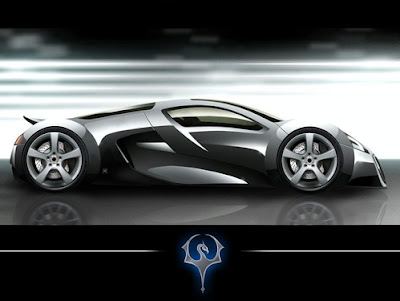
Futuristic Honda The Great Race in 2025
Here comes something beyond our imagination. The Great Race 2025 is a futuristic conceptcar created by Honda. This design is surely inspired by some dragon games because the design looks like an unbelievable car with dragon wings that can be used to fight and travel any kind of track. The concept is designed to fulfill all the demands of a great race in 2025 which will be a toughest race ever devised. The vehicle’s sonar sensors are smart enough to detect the changes in speed, terrain and altitude. If you have enough credit to afford this vehicle, then you must go for it.
Text from designer :
In 1908, 17 men dared to take on the “toughest race ever devised.” Spanning six months, the Great Race brought these men over 22,000 miles, through three continents and around the world. 117 years later, the Great Race of 2025 is tougher than ever.
Competitors must circumnavigate the globe in 24 hours on land through the United States, by sea through Asia and by air over Europe.
The vehicle’s sonar/echolocation sensors are able to detect changes in speed, terrain, and altitude, allowing it to switch to any configuration. With expertise in automotive, marine, robotics, and jet technologies already in place, Honda possesses a distinct, competitive advantage over its rivals, allowing it to lead in the evolution of motorsports in the 21st century.
Source
Aug 4, 2008
The Electracity: Finally, a swanky city car with some trunk space

The Electracity is a city car concept by Piers Prendergast out of London, and it has something a lot of small car designs lack: some serious trunk space. The electric vehicle has an extending rear section of its chassis that'll fold out when you need some room to put suitcases and groceries, and you can reign it back in when you're driving empty. It's got room for two passengers so you can bring a friend, and an automatic sliding door (just like one of our favorite cars).
Check out the gallery below for more of the Electracity city car.


Via Coroflot
Jul 25, 2008
FortuneSport Reveals Specs And Prices For Rt.R And Rt.S

A new serious sports car is about to be born. Dreamt by Teritius Fortune, drawn by Emre Husmen, the Turkish designer that conceived the Husmen 699, and generated by Panoz Group, the FortuneSport Rt.S is a 4.17 m long vehicle that is aimed to weigh only 900 kg and powered by a 6.0-litre V8 engine pumping out 350 bhp.
With such technical specs, the Rt.S will go from 0 to 100 km/h in 4 seconds and potentially reach a maximum speed of 280 km/h. When it goes on sale, somewhere between 2010 and 2013, its price tag is expected to read US$ 85,000. However, before this happens, the world will know its racing version, the Rt.R.
We cannot name the first Fortune customers as owners of the Rt.R because, as awkward as it may sound, they will not own the cars. To be part of the sixty fortunate Rt.R pioneers, a deposit of $200,000 USD will be required. The second step will be travelling to FortuneSport HQ in Atlanta (while staying at luxury hotels), to have the car fitted to the customer. In order to save weight, seats are integrated into the chassis, which will make each Rt.R as personal as a tailored shirt.
When the assembly process is completed, which should take no more than three weeks, according to Teritius Fortune, the final installment of $100,000 will be paid and FortuneSport’s clients will have their cars transported to them. From there they have the right to drive the Rt.R at non-professional track-day events, as well as FortuneSport-sponsored events held with Skip Barber Racing Schools.
“For the most part, the Development Program will be a way to build the brand experience with the customer and to help the engineers build a car that the customers can actually use. We will look at them as pre-production prototypes and as a marketing exercise (images, race tracks, etc.). I know it’s risky, but I think this will work well if we are open with our clients”, said Fortune to WorldCarFans.
The fact that the Rt.R will serve as a development prototype for the Rt.S helps make all the payments of US$ 200,000 totally refundable. “Although repairs and maintenance are borne by the driver, the entire $200,000 amount is refundable once the program comes to a close, anywhere between 3 and 5 years. Part of the money will be used to manufacture the cars, but, as we have to make development prototypes anyway, this is not much of a loss to us”, said Fortune. An almost irresistible investment for anyone that can afford it.
What if you want to keep your Rt.R? You may, of course. “The customer has the option to keep the car once the program is over. In this case, the transaction is converted to a sale. If he chooses to return the car, then we would return the entire amount to him. Of the vehicles returned, some will be destroyed, some will be converted to racing vehicles, some as development mules for the next generation of the Rt.S, and a few to the FortuneSport Museum (if there should be one at that point)”, said Fortune.
When asked, most people would you pay $200,000 (with full refund) to drive a 900 kg, 350 bhp car? However, the Rt.R is 150 kg lighter and 160 bhp stronger than the Rt.S, putting its weight at 750 kg with 510 bhp. Keep in mind the Rt.S goes 0 to 100 km/h in 4 seconds and top speed of 280 km/h - considering there will be only 60 of them, you should be quick to make your deposit. The Rt.R program begins by the end of this year.
Source: FortuneSport
Jul 24, 2008
DIESEL Micro Car Project by Aaron Cardozo
Consistent with DIESEL’s philosophy of Innovation and Individuality, the Micro Car is a visionary vehicle that aims at becoming the transport option of choice for young commuters in the year 2020. Standing at 3 meters long, 1.8 meters wide and 1.5 meters tall, the concept created by Aaron Cardozo operates on 4 electric in-wheel motors that are powered by a battery pack underneath the floor. Wheels themselves are hub-less but the motor-brake assembly at the center of each wheel acts as a hub and the entire layout offers better weight balance and a lower center of gravity to the vehicle.

With replaceable panels for the body and the roof bar available in various colors and textures and wheel covers offered in a variety of patterns and materials (transparent/translucent/opaque), users get limitless customization options on the exterior as well as the interior where forward facing seats can be switched over to face the rear.
A combination of denim and leather in the seats and interior trim reflect the true sprit of DIESEL apparel and accessories while a Central Control System(CCS) laced with HVAC system, entertainment system, GPS, and car information system, etc, provides the necessary tech boost to the gen-next drivers. An LCD screen displays vital information on the Center Console which can also be projected on to the windshield as a Heads Up Display (HUD).
The car can be recharged via a regular power outlet or by the energy obtained by regenerative braking, and by solar panels incorporated on the rooftop glass panels. Crafted to be a 2+2, with 2 primary seats as well as 2 jump seats that fold out from the tailgate suitable for adults for short distances or for children, the Micro Car reflects the individualistic spirit of DIESEL in the truest possible way.
May 25, 2008
5 Best Selling Green Cars
1) Honda Civic GX
The Honda Civic GX was the Japanese company's response to offer the best technology to combat air pollution and rising Crude Oil prices. Resting under the bonnet is the cleanest Internal combustion ever made. The natural gas powered Civic GX is very firm when it comes to hugging trees, thanks to the near zero emissions from its engine.
Talk about safety, and it gets a bit more interesting. The Civic GX hasn't shed any of the safety features that its gasoline engine variant boasts of. All the safety features, dual front airbags, front passenger's side impact airbag, ABS and Honda's Advanced Compatibility Engineering Body structure TM (ACE TM), come standard, so there is no compromise on the safety aspect.
CNG is a safe fuel as in the event of a leak, the gas would dissipate into air rather than how gasoline drips and collects under the car. CNG has a higher Octane rating than conventional gasoline thereby allowing the engine to operate at a higher compression ratio which results in elevated efficiency.Maintenance is cheap as carbon deposits in the engine are not present which is not the same condition observed with gasoline fueled engines. As a result, oil change is required only once every 10,000 miles. Costly overhauling jobs are avoided because of carbon deposits' absence.
The Civic GX was not a car that happened due to the success of the conventional Civic. It was in fact built and developed alongside its petrol sibling to offer customers a car that was easy on their wallet and on the environment. One of its renowned accolades was the prestigious Motor Trend Car of year award in 2006.
2) Toyota Prius
One million Toyota Priuses have been sold so far since its birth back in Japan in 1997. Sold in 40 countries, the Prius was Toyota's answer to Global warming and increasing Crude Oil prices. It claims to be the most fuel-efficient vehicle sold in the U.S.A. It is also the second least C02 (Responsible for climate change) emitting vehicle in the U.K. Sounds very green!
It all started in 1994 when Toyota decided to produce a vehicle that would serve dual purposes - Cheap to run and easy on the environment. They decided the best manner to approach both the hassles was by developing hybrid technology. Some of the key aspects of the vehicle are discussed briefly:*A smart choice of engine - The engine is operated on Atkinson cycle principle instead of the conventional Otto cycle. The engine also shuts off during traffic stops and the various accessories like the the air conditioner, which would normally run on the engine's power, are instead powered by a battery pack. The engine is used both to propel the vehicle and to recharge the batteries. Due to the assistance provided by the batteries, the engine could be downsized and tuned for fewer emissions and better fuel economy.
*Two electric motor/generators- Used to start the engine and provides counter torque for the Continuously Variable Transmission (CVT). The motor-generators is one unit but plays two roles. It acts like a starter motor to rev the engine up to life and acts as a generator to convert the kinetic energy of the rolling wheels into electrical energy at the battery.
*A nickel metal hydride (NiMH) battery pack providing voltage for propelling the vehicle, which is supplied by Japan's Panasonic. To increase battery life, the batteries are charged only to about 50% of the maximum capacity.
*Regenerative braking is used using motor-generators, which converts kinetic energy of motion into electrical energy that is stored in the battery. Wear on brake pads reduce and the battery also gets charged this way, doing away with plugs or wires that an electric car would usually have.
*An aerodynamically favorable shape gives the Prius a Cd value of 0.26, which is prolific. The Kammback design helps the cause along with lower rolling-resistance tires.
*Light weight materials are in used in the construction of the body and some parts.
*Hybrid Synergy Drive (HSD) is the heart of the car processing the inputs and producing equivalent outputs.
The Prius achieved 5 maximum stars in the Euro NCAP crash tests in 2004. It has won several awards in the past for its technology, design and environment-friendly operation.
# 1997–98 Car of the Year Japan
# 2003 Scientific American named Toyota Motor Corporation as "Business Leader of the Year" ("Scientific American 50"; December, 2003) for its singular accomplishment in the commercialization of affordable hybrid cars.
# Motor Trend Car of the Year 2004
# Car and Driver magazine's Ten Best list for 2004.
# North American Car of the Year award for 2004. Nominated in 2001.
# International Engine of the Year for 2004.
# "Best Engineered Vehicle for 2004" by SAE's Automotive Engineering International magazine.
# 2005 European Car of the Year.
# 2006 EnerGuide Award
# 2006 Intellichoice Best Overall Value of the Year, Midsize
# 2007 Intellichoice Best in Class Winner :Best Retained Value, Lowest Fuel, Lowest Operating Costs, Lowest Ownership Costs
# Swiss government named Toyota Prius the world's greenest car in a draft study of over 6,000 cars
3) Honda Civic Hybrid
This is Honda's hybrid answer. The Honda Civic hybrid showcases Honda's renewed commitment to Hybrid technology and gives drivers a environmentally friendly car without any compromise on style, performance or comfort.
Honda's Hybrid system is called Integrated Motor Assist (IMA). Developed in 1999 it was first launched in the 2 seat-er Honda Insight which gave an idea of how advanced it was - 83 miles per gallon on a combined cycle.
Hybrid is the combination of a petrol engine with an electric motor. The electric motor is coupled to a powerful battery. The electric motor helps the engine by giving it a boost during acceleration and solely runs the car at idle to reduce emissions and fuel consumption. The battery that powers the electric motor charges itself up with regenerative energy from deceleration and braking. A regenerative brake is a mechanism that reduces vehicle speed by converting some of its kinetic energy into electrical energy. A brake pedal sensor sends a signal to the car's computer, activating systems whenever the driver applies the brake. This allows braking energy from the wheels to be stored as electrical energy in the high voltage battery for future use. Therefore the car never needs to be recharged from an external power supply. This regenerative brake assistance also extends the life of the brakes and their components as it reduces its workload appreciably.
The majority of the hybrid cars available in the market today aren't that good looking. And nobody wants to drive around in a car that looks like a deflated football. Honda engineers have taken note and engineered the components to enhance looks and more importantly, help achieve their primary targets.The elegant styling combines a sweeping roof-line, a sharply raked windscreen and short overhangs that contribute to the vehicle's advanced mono-form profile. Superior aerodynamics is achieved by ultra-tight body panels that fit firmly around the monocoque frame. A chin spoiler and a lip spoiler are also designated to aid the aerodynamics by reducing turbulence beneath and behind the car. The low-drag alloy wheels are made specifically for the Civic Hybrid so to enhance the looks and reduce excess weight while the opposable windscreen wipers serve both styling and efficient cleaning purposes.
The fuel tank is made from an innovative six-layer polyethylene composite material that blocks fuel evaporation and saves weight. The front sub-frame which accommodates the engine and transmission is produced from hydro-formed elements for increased strength and rigidity. Special rubber floating mounts minimize the level of road and engine NVH (Noise, Vibration, Harshness) entering the passenger cabin.
But it's not all about the looks. Honda's new IMA system gives out more power than a conventional 1.6-litre engine (115PS), but only uses the same amount of fuel as a 1.1-litre car. There's no ambiguous starting procedure or complicated operating system – it looks and drives like a modern, stylish saloon with a top speed of 115mph. The Civic Hybrid's engine took top honors for three successive years at International Engine of the Year "1 litre to 1.4 litre" size category award from 2002 through 2004 and the "Best Fuel Economy" category for 2003 and 2004.
The Civic hybrid is one of the safest cars in its class. It is equipped with ABS and Electronic Brake force Distribution (EBD) to achieve decent stability and high braking performance. Vehicle Stability Assist (VSA) assists the driver in maintaining maximum possible control during cornering, acceleration and sudden manoeuvres by applying braking either to the right or left wheels accordingly while controlling the throttle and brake systems simultaneously.
The Civic Hybrid uses multiple "load paths" to limit penetration of the car's structure by absorbing more of the crash energy if it encounters a collision. Whatever energy gets through is mitigated by the car's eight standard air bags. The Civic Hybrid has earned top safety rankings from NHTSA and IIHS. To help reduce pedestrian injuries in the event of a collision, the Civic Hybrid's bonnet and wing areas are designed to deform if contacted by the head of an adult or child pedestrian. Energy-absorbing collapsible bonnet supports, wiper arms and wing mounts are designed to allow a degree of deformation in an impact making this car very safe to travel in.
4) Nissan Altima Hybrid
Nissan's contestant in the world of hybrid sedans is the Altima Hybrid. Straight away, the Altima catches your eye with distinct body creases, wide hips, tapered roof-line, T-shaped front grille, and indented wheel-well arches.
A modified version of Toyota's Hybrid Synergy Drive system finds its place in the Altima Hybrid. The result is proven technology and components from Toyota that meets Nissan's refined 2.5-liter engine. The five-passenger Altima Hybrid sedan is the most fuel-efficient Nissan ever, frugal even than the smallest car in the Nissan range.
The Altima Hybrid power-train is combined to Nissan's QR25 2.5-liter 4-cylinder engine and standard electronically controlled CVT with an advanced electric drive motor/generator that maximizes fuel economy and produces low tailpipe emissions. The car is rated as an Advanced Technology-Partial Zero Emissions Vehicle (AT-PZEV) and suffers almost no evaporative losses.
The Altima Hybrid utilizes regenerative braking technology to recharge the hybrid system's batteries. In the event of braking, a generator places resistance on the drive-shaft converting kinetic energy into electrical energy which is sent to the battery. Altima Hybrid's Regenerative Cooperative Brake System calculates braking force generated by brake pedal operation and controls the energy exchange operation.The advanced energy drive system manipulates between the gasoline-powered 4-cylinder and the emissions-free electric motor – allowing Altima Hybrid to operate entirely on electric power like an electric car, and majority of electric-only usage comes in city driving. If extra performance is needed when on the highway, the gasoline engine comes to life almost immediately and adds power as per requirement. Due to all the hustling and swapping, the Altima Hybrid has a fuel economy estimated at 35 mpg City and 33 mpg Highway by the EPA.
To process power efficiently and smartly and to provide smooth acceleration and cruising, the Altima's hybrid system-specific eCVT is present, which works in sync with the Hybrid Vehicle-Electric Control Unit (HV-ECU), determines whether the motor or the engine or a combination of both would drive the wheels.
The electric motor churns out high torque at low rpm, a characteristic that is used well during the acceleration of the car from a standstill without using any of the engine's power. This stage is a fuel efficiency killer and hence the motor has got this area well covered contributing to the car's high gas mileage.
The engine on the latest Altima has been tweaked for better performance. A larger intake manifold, increased compression ratio and reduced friction characteristics are the improvements over the previous version. Other than that, the engine features continuously variable valve timing, modular engine design, micro-finished crank journals and cam lobes, molybdenum-coated lightweight pistons and electronically controlled throttle, making it fuel efficient and less polluting without upsetting performance.
Just like in any other hybrid car, a digital output on the speedometer displays which power source the car is running on to give the driver all the information he needs.
Nissan has taken serious efforts to make this car safe and hence all safety equipment comes standard which includes six air bags, front-seat active head restraints to reduce whiplash injuries, as well as stability control and traction control.
Altima Hybrid has been certified to meet California emissions requirements and is sold in places that have adopted California emissions regulations: California, Connecticut, Maine, Massachusetts, New Jersey, New York, Rhode Island and Vermont. These eight places are among the important markets for hybrid vehicles.
Nissan states that it "will continue to develop hybrid vehicles not only as means of complying with environmental legislation but as key technology to deliver new value to customers."
5) Toyota Camry Hybrid
The Toyota Camry Hybrid is the hybrid variant of the popular Camry sedan. Introduced in 2006, the Camry Hybrid sells in large volumes making up 15 percent on the total Camry sales. The Camry combines comfort, power and gas mileage with the use of hybrid technology.
The Camry uses Toyota's advanced HSD (Hybrid Synergy Drive) system which also features on the Prius and the Nissan Altima. The first bit of the Camry's Hybrid drive-train is a 2.4 liter, four pot gasoline engine which produces a peak power of 147 horsepower. The second half is a high-powered electric motor and a 244-volt battery pack which delivers 45 hp. The battery pack contains 34 nickel metal hydride modules, each of which contains six 1.2-volt cells.
Send all that through a continuously variable transmission, it totals to 192 horsepower, 34 more than the standard Camry. More power is always accompanied with good acceleration figures which is evident in the the Camry Hybrid as 0 – 60 comes up in 8.9 seconds, nearly a second faster than the other hybrid model in the Toyota arsenal, the Toyota Prius.
An interesting story during the development stages was on the location of the extra electronics. The engineers wanted to avoid spoiling the spaciousness of the car and after endless trials and suggestions, the area behind the rear seat was chosen to accommodate the battery module, monitoring unit, system main relay, service plug, and DC-DC converter as a single mainframe.Some of the notable features in the Camry Hybrid include an "ECO" button that reduces energy sapped by the Heating Ventilating Air Conditioning (HVAC) system and under certain conditions. As the HVAC depends on the energy produced by the engine, it is one of the biggest burdens resulting in increased fuel consumption. This technology helps in that aspect by reducing the load.
Safety wise, the Camry hybrid earned a five-star safety rating in the tests performed by the National Highway Traffic Safety Administration (NHTSA) for frontal crashes for both driver and passenger. It also received a five stars safety for side impact crashes for driver and passenger.
Just like in the case of the Prius, Toyota have made the Camry aerodynamic. The drag reducing wheel spats and under-body pans help the cause giving the car a Cd value of 0.27.
The Camry Hybrid arrives with a big list of standard features. These include a tire-pressure monitor system, halogen headlamps with automatic on/off, cruise control, a tilt and telescopic steering wheel, an eight-way-adjustable power driver's seat, a 60/40 split fold-down rear seat, 16-inch aluminum wheels, heated outside rear-view mirrors, dual-zone automatic climate control heating and air conditioning with a Plasmacluster(TM) ionizer, micro dust and pollen filter.
In 2007, the Camry Hybrid was judged Car of the Year in the Family Sedan (over $30k) category by the Automobile Journalists Association of Canada (AJAC).